

May 2026
Impersonators or proxy candidates might once have been individuals serving a small circle of clients operating through word of mouth. Today, they are organised networks offering bundled cheating services that are promoted online and easily accessible. It is no longer about who you know, as these services are open to anyone willing to pay.
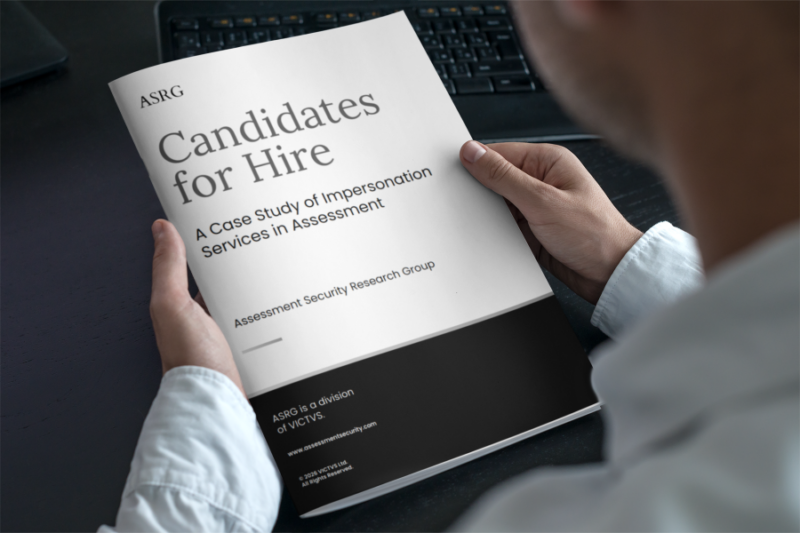
In our latest paper, Candidates for Hire: A Case Study of Impersonation Services in Assessment, ASRG examines the current market for impersonation and proxy candidate services through a detailed case study of a website that boldly advertises its services globally. It charges high fees and promotes discretion, while deliberately maintaining a low profile. It is not hidden in obscure corners of the internet. It exists in plain sight, but only if you know where to look.
Services such as this one rely on a range of tools and methods designed to avoid detection. This includes remote access software, hidden devices, or discreet communication during assessments. In some cases, impersonators use fake IDs, which can also be sourced online. For remote assessments, operators may coach candidates to behave naturally on camera or control sessions in a way that mimics normal test behaviour to avoid raising suspicion. For in-person assessments, disguises may be used to pass identity checks. Increasingly, these operations appear to be part of larger organised groups that provide complete cheating solutions, combining technology, tools, and impersonators into a single service for paying candidates.
The implications are significant. When impersonation services succeed, the credibility of qualifications is undermined, institutions face reputational risk, and legitimate candidates are placed at a disadvantage. In some cases, this is not just a matter of fairness but a health and safety risk.
Raising awareness is a critical first step. By understanding how these services operate, assessment providers can strengthen their defences, identify suspicious patterns, and establish more effective responses. These services rely on remaining unnoticed. Bringing them into the open threatens the discretion their business relies on.
The whitepaper explores the tactics and implications of this issue. The question is not whether these services exist, but do they work? Are they like the many other cheating service scams? And most importantly, if they do work, how can they be stopped?
We invite you to read our whitepaper and let us know your thoughts. To access the whitepaper, please Click Here.
Join ASRG today to keep up to date with our research and to stay informed on the latest changes in assessment security.
Follow this link for more information about ASRG membership.
ASRG: Working together to make assessments fairer and more secure for everyone.